
What Garden Records Should You Keep From Year to Year?
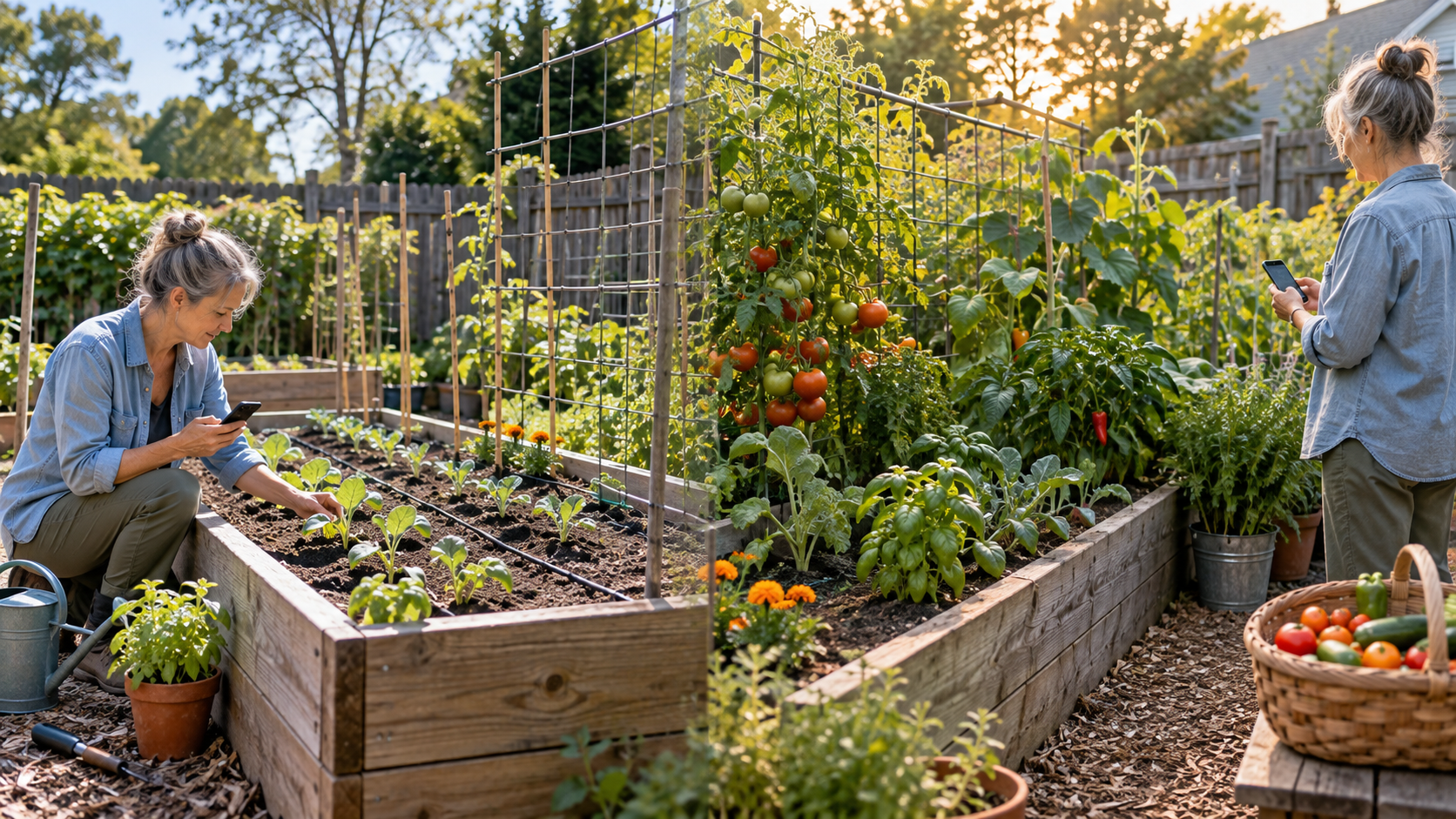
The first year you keep garden records, you are mostly trying to remember what happened.
By the second and third years, something more interesting becomes possible.
You can compare.
Did the Sungold tomatoes ripen earlier? Did the cucumbers develop powdery mildew around the same time? Did peppers really perform better in the patio containers, or does it only feel that way? Which garlic planting date gave you the best result?
A single season gives you memories. Several seasons can give you patterns—but only if you record enough of the same information each year to make the comparison useful.
The best long-term garden record is a small, consistent core of facts and observations that helps you understand what changed and decide what to do next.
What makes a garden record useful across years?
A detail becomes valuable over time when you can connect it to the same plant, place, event, or decision in another season.
“Tomatoes did well” may preserve a feeling.
That version gives you something you can compare.
Useful long-term records usually have three qualities:
- They identify what and where you are talking about.
- They include timing or sequence.
- They preserve the result or your interpretation of it.
You will not always have perfect quantities or exact dates. Consistency matters more than laboratory precision.
An approximate but clearly labeled record is better than inventing certainty later.
The minimum garden records worth keeping every year
If you want the broader framework first, start with our complete guide to keeping a garden journal or review what to write in a garden journal .
1. Plants, varieties, and counts
Record what you grew, including the variety and number of plants when you know them.
Variety names make comparisons far more meaningful. A Cherokee Purple and a Sungold are both tomatoes, but they may differ in timing, flavor, disease response, cracking, and production.
Counts add context. Ten pounds from two plants tells a different story than ten pounds from eight plants. Even an approximate count helps.
Keep consistent
Use the same crop and variety names from year to year. If you correct a label or learn the variety later, update the record rather than creating a second name for the same plant.
2. Garden areas and locations
Record where each crop grew. Beds and containers can differ in sunlight, drainage, wind exposure, soil, and competition.
Location helps you see whether a result followed the variety, the area, or both.
Keep area names simple and stable: Bed 1, Bed 2, patio containers, back fence, or herb planter.
Keep consistent
If the garden layout changes, note the change. Do not quietly reuse an old area name for a completely different space without explaining it.
3. Planting and transplanting dates
Dates help explain whether a crop started earlier or later and how long it took to reach important milestones.
Record sowing, transplanting, and major succession plantings at the level that matches your goals.
For fall-planted crops such as garlic, the year label can be confusing. Preserve the actual planting date and harvest date so the record follows the crop across calendar years.
Keep consistent
Distinguish between planned and completed actions. “Plant garlic next weekend” is a task. “Planted 48 garlic cloves in Bed 3 on September 23” is a planting event.
4. Milestones and timing
First germination, flowering, fruit set, first harvest, peak production, bolting, and final harvest create a timeline of the season.
You do not need every milestone for every crop. Choose the ones that answer questions you actually ask.
First and last harvest dates are especially useful when you want to compare the productive window of a crop. For another gardener, flowering or pest arrival may matter more.
Keep consistent
Use the same milestone definitions. If “first harvest” means the first ripe tomato one year, do not use it to mean the first large picking the next.
5. Problems, treatments, and outcomes
A record that says “powdery mildew” is a start. A long-term record should also identify when it appeared, which plants and areas were affected, what you tried, and what happened afterward.
This creates a sequence you can compare:
Without the follow-up, you may remember using a treatment but not whether it seemed to help.
Keep consistent
Record what you observed separately from what you concluded. A plant improving after a treatment does not prove the treatment caused the improvement.
6. Harvest timing, quantity, and quality
Harvest records can reveal productivity, timing, and whether a crop was worth the space.
Choose a level you can maintain: exact weight, count, basket, handful, or first and final harvest only.
Quality deserves a place beside quantity. A tomato can produce less and still earn another year because the flavor was exceptional. A bumper crop can be a poor choice if no one wanted to eat it.
Keep consistent
Use stable units when you want totals. If you switch from pounds to counts or from exact weights to “a bowl,” note the change and avoid false comparisons.
7. Repeat, avoid, and change decisions
These may be the most useful records of all because they preserve your judgment while the season is fresh.
The reason matters too. “Avoid” is less helpful than “avoid because it split badly after rain and the flavor did not justify it.”
Keep consistent
Review these decisions before buying seeds or assigning beds. A record you never revisit cannot improve next year’s plan.
Records to keep when they explain the season
Some information matters enormously one year and barely at all the next. Capture it when it helps explain a result.
Unusual weather
Record late frost, heat waves, heavy rain, drought, hail, or another event when it affected the garden.
You rarely need to type daily weather by hand. The connection to the plant is the useful part: what happened, when, and what you observed afterward.
Soil amendments and fertilizer
Record the product or material, amount when known, date, area, and reason.
If you are comparing outcomes, follow up with what you noticed. Avoid assuming an amendment caused every later improvement.
Watering changes
Routine watering may not deserve a daily record. A change in method, frequency, irrigation system, or response during drought probably does.
Garden layout changes
A new bed, moved container, removed tree, or added shade can change the context of future comparisons.
Record the change so an apparent plant pattern is not actually a location change you forgot.
Seed sources and trials
Seed source, lot, growing method, or special trial details matter when you are intentionally comparing them.
They do not need to become permanent required fields for every crop.
What not to compare too quickly
Year-to-year garden records are evidence, but they are not controlled experiments.
Weather changes. Plant counts change. Soil improves. Pests arrive. You water differently. A new tree casts shade.
If one tomato variety produced more in 2026 than in 2025, the variety may have performed better—or it may have had more plants, a sunnier bed, earlier planting, fewer disease problems, or more consistent watering.
Use records to notice patterns and form better questions. Be careful about declaring a cause from one comparison.
Three repeated observations can be more persuasive than one, but gardening will always contain variables you did not measure.
That is not a reason to stop recording. It is a reason to interpret your history honestly.
Create a short end-of-season record
Individual entries capture the season as it happens. A short annual summary makes the history much easier to use.
At the end of each season, answer:
- What performed best, and why do I think so?
- What struggled, and what may have contributed?
- Which varieties will I repeat or avoid?
- Which garden areas worked especially well or poorly?
- What problem should I watch for earlier next year?
- What is the one change I most want to make?
Keep the summary grounded in the entries you made. It can be a page, a paragraph, or a few spoken observations.
The goal is to preserve the decisions, not to write an annual report.
How to keep multi-year records usable
Use stable names
Consistent plant, variety, and area names make search and comparison easier.
Correct duplicates early instead of letting “Sungold,” “Sun Gold,” and “yellow cherry tomato” become three separate histories.
Preserve dates
A note may make sense in the moment without a date, but dates are what place it in a season.
Past-dated memories should retain the date they happened, not merely the date you entered them.
Separate observations, events, harvests, and plans
“The basil looks pale,” “fertilized the basil,” “harvested basil,” and “fertilize next week” describe different things.
Keeping those distinctions clear prevents inaccurate histories and makes future questions easier to answer.
Keep the original context
Totals are useful, but they should not erase the notes behind them.
If a number changes after an entry is edited or deleted, the summary should change too. Your source records remain the foundation.
Back up or export what matters
Whatever format you use, know how your records are preserved.
Paper can be photographed. Spreadsheets and files can be backed up. For an app, understand its account, export, and deletion options as they become available.
The longer the history, the more useful recall becomes
By the third season, you may have hundreds of entries. That is when finding the right detail becomes harder than capturing it.
Garden Recall is built around both parts of the problem. Voice-first recording helps you save events, observations, harvests, tasks, and seasonal ideas while you are in the garden.
Ask My Garden helps you question your own history later and shows the memories behind its answer.
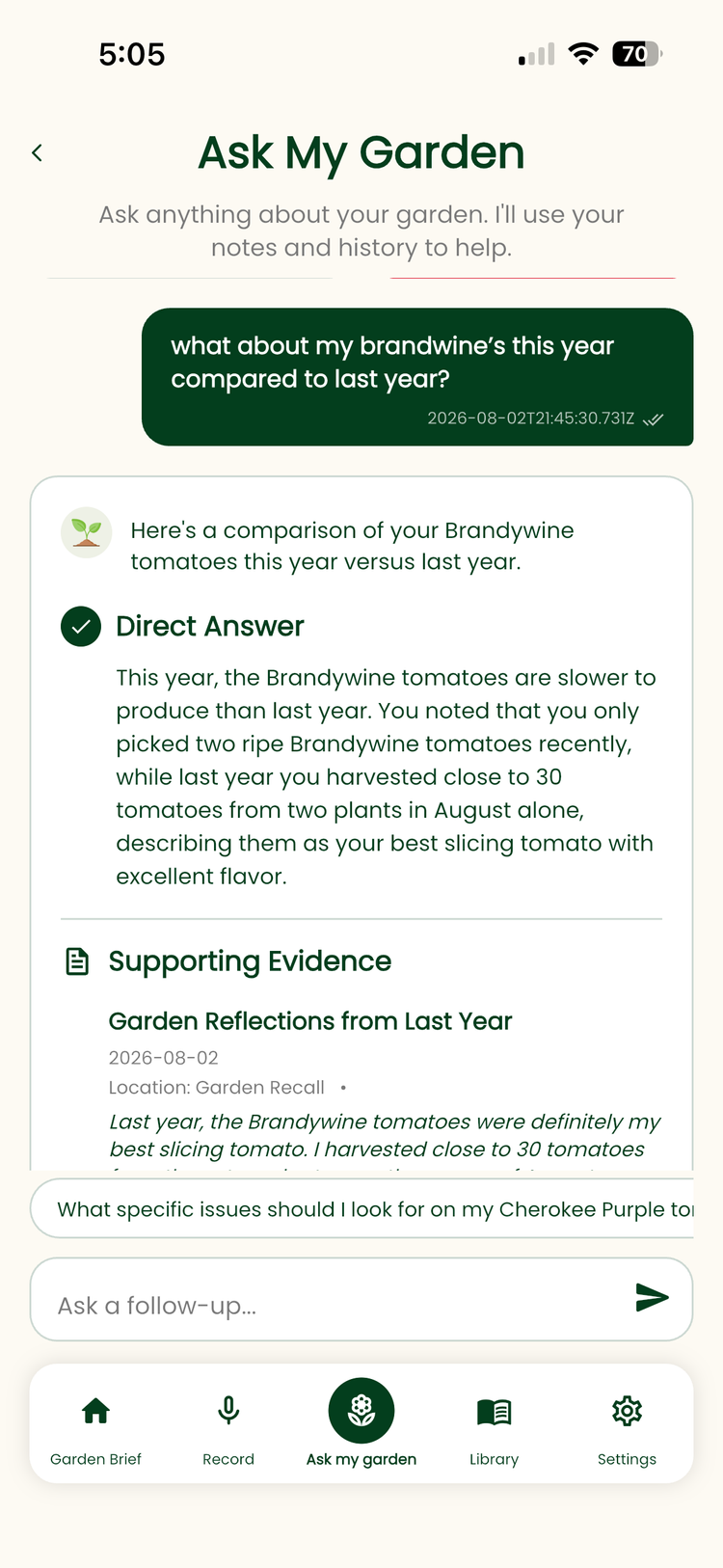
You might ask, “When did powdery mildew first appear on the cucumbers each year?” or “Which tomato varieties have I said I would grow again?”
The answer becomes more useful because it is grounded in several seasons of your own records.
You are not collecting facts to admire them. You are building a memory your future garden can use.
Start with the five records that compound
If a seven-part system still feels like too much, keep five things consistent:
What you grew
Keep the crop, variety, and count consistent enough to recognize it next season.
Where you grew it
Use stable garden-area names so you can compare one location with another.
When the important events happened
Preserve the timing that gives the season context.
What result you observed
Record what actually happened, including quality, problems, and uncertainty.
What you decided to repeat, avoid, or change
Preserve the decision while the evidence is still fresh.
Capture those reliably, and you will have enough context to ask better questions next season.
Add quantities, weather, inputs, and other detail when they serve a real purpose.
The best multi-year garden record is not the most complete one. It is the one that remains clear, trustworthy, and usable long after the season ends.
Try Garden Recall
Garden Recall is the voice-first garden journal designed to help gardeners capture useful memories and recall them across seasons.
Speak naturally, review the organized record, and ask questions about what happened in your own garden.
Explore Garden Recall