
The Best Way to Keep a Garden Journal When You Hate Journaling

You do not need convincing that keeping a garden journal is a good idea.
The problem is actually keeping one.
At the beginning of the season, it sounds completely reasonable. This will be the year you write down what you planted, where you planted it, when the first tomato ripened, which cucumber variety produced like crazy, and what on earth finally worked against the powdery mildew.
Then the garden gets busy. Your hands are dirty. The sun is hot. Something needs watering, something else needs harvesting, and a hornworm has appeared with no respect for your plans. By the time you come inside, writing a detailed journal entry is no longer high on the list.
I know this because I am exactly that gardener. I have always understood the value of garden records. I just never wanted to stop gardening long enough to keep them.
So if you have started notebooks, spreadsheets, apps, or photo folders and quietly abandoned all of them, this is not another lecture about becoming more disciplined. The answer may be to make your garden journal much easier.
Why garden journals are so easy to abandon
Most garden-journaling advice begins with a long list of things you could record: planting dates, varieties, weather, pests, treatments, harvest weights, bed layouts, soil amendments, successes, failures, and plans for next year.
All of that information can be useful. But a system that expects you to capture everything can quickly turn a hobby into data entry.
The friction usually appears in small steps. Find the notebook. Locate the right page. Open the spreadsheet. Scroll to the correct row. Select the plant. Choose an event. Enter a date. Type the note. Save it. None of those tasks is especially difficult on its own. Together, they are enough to make “I’ll do it later” feel like the sensible choice.
Later is where garden details disappear.
You may remember that the Cherokee Purple tomatoes were good. But were they the ones that cracked after heavy rain? Did they grow in Bed 2 or Bed 3? How many plants did you have? When did the first one ripen?
Memory keeps the general impression and quietly drops the details that would help next season.
Start with what you will actually use later
A useful garden journal does not need to document every trip outside. It needs to preserve the moments that affect a future decision.
When something makes you think “I need to remember this,” that is probably worth recording.
For most vegetable gardeners, a practical journal can begin with five kinds of information:
- What you planted, including the crop and variety when you know it.
- Where and when you planted or transplanted it.
- What changed, including flowering, ripening, pests, disease, and unusual growth.
- What you harvested and how it performed.
- What you want to repeat, avoid, or do differently next time.
That is enough to answer meaningful questions later without requiring a daily gardening diary. If you enjoy recording weather, soil details, photographs, or harvest totals, add them.
Do not let an ideal record prevent you from creating a useful one.
Choose the lowest-friction format for you
There is no single correct garden journal. The best format depends on what feels natural enough to keep using.
A paper notebook
Paper is immediate, flexible, and satisfying. You can sketch a bed, tape in a seed packet, or write one sentence without thinking about a screen. It works especially well for gardeners who already enjoy writing by hand and keep the notebook somewhere they will see it.
Its weakness is retrieval. A note can exist and still be hard to find six months later. Paper also asks you to have clean enough hands, a pen, and the notebook nearby at the moment something happens.
A spreadsheet
A spreadsheet is excellent for gardeners who like rows, totals, sorting, and consistent categories. It can be especially useful for seed inventory or harvest tracking.
But spreadsheets require structure. If opening the file already feels like work, you probably will not reach for it while standing beside the tomatoes.
Photos and phone notes
Your phone is already with you, which removes one barrier. A quick photo or note is better than relying on memory alone.
The challenge arrives later, when useful garden details are mixed with grocery lists, screenshots, and hundreds of other photos.
A garden journal app
An app can connect plants, dates, garden areas, harvests, tasks, and observations. That structure makes records easier to search and use later.
The tradeoff is that some apps require so many taps and fields that recording the garden begins to feel like maintaining the app.
The right choice is the one with the least resistance for you. You are allowed to use a beautiful notebook. You are allowed to love a spreadsheet. You are also allowed to admit that neither survives your actual gardening season.
Make each entry smaller
One reason journaling feels heavy is that we imagine every entry needs to be complete.
It does not.
A useful garden note can be one sentence:
Each note preserves a specific fact. Across a season, those small facts become a history.
That history is far more valuable than the elaborate journal you intended to keep but stopped updating in June.
Record the moment while it is still a moment
The longer you wait, the more a garden observation loses detail. “I harvested tomatoes this week” is not the same as “I picked six Cherokee Purples from Bed 3 after two days of rain, and several were cracked.”
The easiest time to capture that information is usually when you are looking at it.
This is why voice can work so well in a garden. You do not need clean hands, a long form, or perfectly composed sentences. You can simply say what happened and keep moving.

A voice note by itself reduces the effort of recording. A voice-first garden journal can go further by turning that ordinary sentence into useful structure: the plant, variety, garden area, event, harvest, observation, or task behind what you said.
That is the idea behind Garden Recall. I wanted to be able to talk naturally about one garden area at a time, include multiple plants or observations when needed, and let the app organize the details. I did not want to stop and build the record field by field.
For example:
“In Bed 3, I picked six Cherokee Purple tomatoes and four Sungolds. The Cherokee Purples are cracking after the rain, but the Sungolds look great.”
The value is not merely saving an audio file. The value is creating garden memories I can find and use later.
A garden journal should answer you back
Recording information is only half the problem. The real payoff comes when you can retrieve it at the moment of a decision.
In winter, while choosing seeds, you may want to know which tomato variety you said you would grow again. In spring, you may wonder when you planted garlic last year. In summer, you may want to remember whether powdery mildew appeared at the same time the previous season or which treatment seemed to help.
If finding the answer requires rereading months of notes, you may never use the record you worked so hard to create.
Garden Recall includes Ask My Garden for that reason. Instead of remembering which page or entry contains the answer, you can ask a question about your own recorded garden history and see the memories behind the response.
The journal becomes more than an archive. It becomes something you can consult.
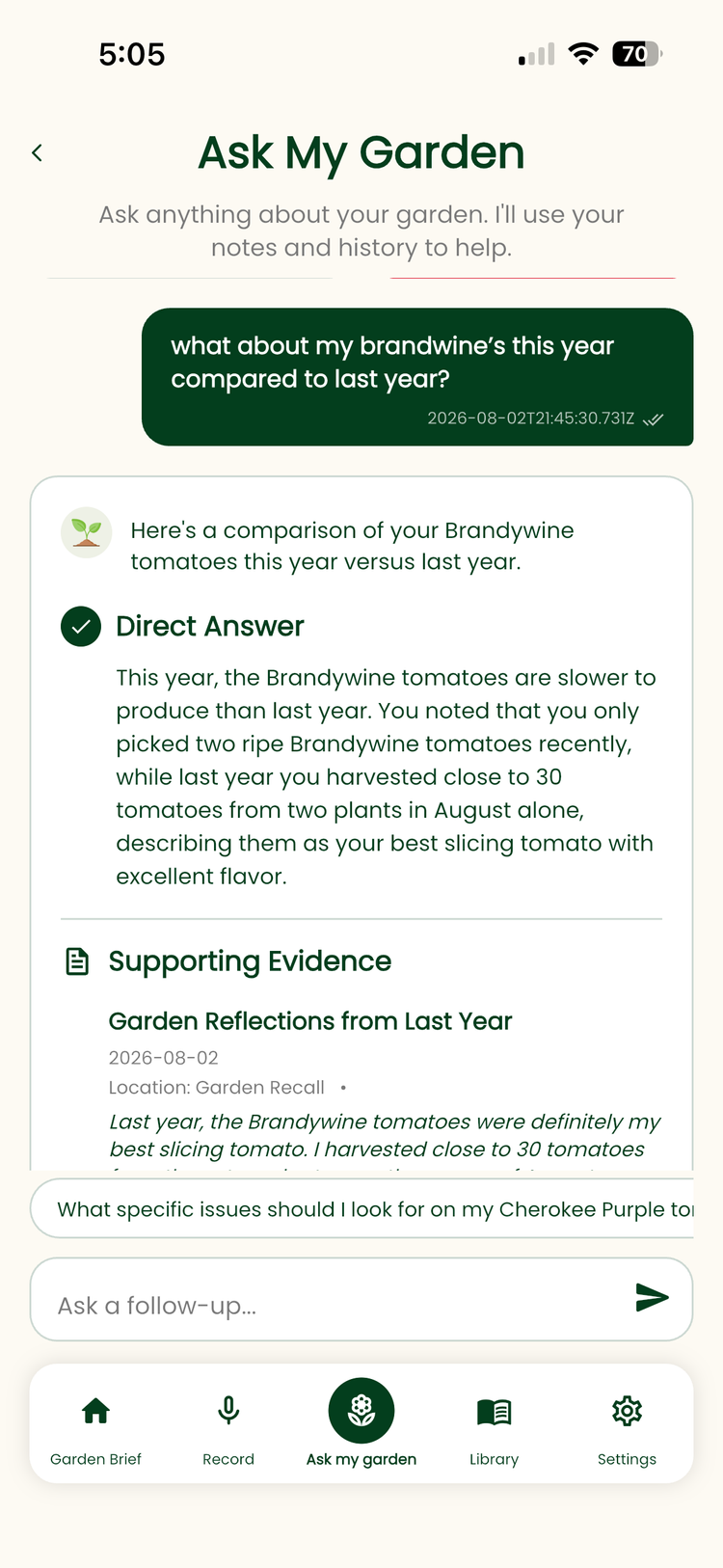
That is the part of garden journaling I find most exciting. We are not keeping records for the sake of having records. We are keeping them so next year’s decisions can be informed by what actually happened in our own gardens.
A simple garden journaling routine that can survive summer
If you want to begin without creating another complicated system, try this:
Pick one capture method
Choose the notebook, note app, spreadsheet, or garden app you are most likely to use outside. Do not build parallel systems unless you genuinely enjoy maintaining them.
Record decision-worthy moments
Capture plantings, firsts, problems, harvests, surprises, and anything you want to repeat or avoid. Skip ordinary days when nothing feels worth preserving.
Keep entries short
One clear sentence is enough. Specific details such as variety, location, quantity, and what you noticed will make that sentence more useful later.
Review before the next season
Before ordering seeds or assigning beds, look back. Which varieties earned another year? Which problems repeated? What did you wish you had done sooner? A garden record becomes valuable when it changes a choice.
Let the system grow with you
You do not need to design a perfect multi-year archive on day one. Begin by saving what you would otherwise forget. Consistency becomes easier when the benefit is visible.
The best garden journal is the one you do not have to force yourself to keep
If traditional journaling already works for you, keep doing it. A shelf of handwritten garden notebooks is a wonderful thing.
But if your garden journal repeatedly ends after a few enthusiastic entries, the problem may not be you. The method may simply ask for more attention than you want to give it during the busiest part of the season.
Your journal can be lighter. It can be occasional. It can sound like you. It can begin with one sentence spoken while you are still standing in the garden.
The goal is not perfect documentation. The goal is to give your future self something better than, “I know I grew that before, but I cannot remember what happened.”
Meet Garden Recall
Garden Recall is the voice-first garden journal I created for gardeners who want the benefit of garden records without turning gardening into paperwork.
Record what is happening in your own words, let Garden Recall organize it, and use Ask My Garden to find those memories later.
Explore Garden Recall